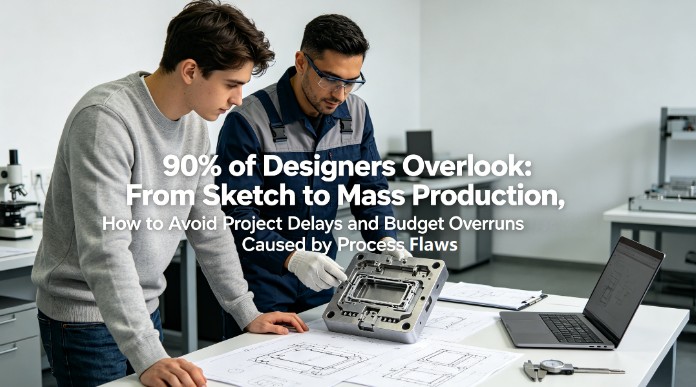
Many designers and startup teams face frustrating challenges when transforming digital concepts into physical products: cost overruns, samples that deviate from expectations, and delivery delays. These setbacks often derail promising projects before they reach the market.
The root cause is a lack of understanding of manufacturing process constraints and supply chain complexities during the early design phase. This knowledge gap forces costly redesigns and schedule extensions later. This article reveals how leveraging professional sheet metal stamping services bridges the gap between design and production, ensuring your creative vision is realized efficiently. You will gain a systematic guide covering material selection, supplier evaluation, and global delivery, helping you protect your project timeline and budget.
Why Do My Design Drawings Always Deform or Have Incorrect Dimensions After Prototyping?
The gap between design intent and manufacturing reality is the primary source of prototype failures. Many designers overlook material springback behavior and stamping process limits, leading to dimensional deviations in samples.
- The Physics of Springback and Process Limits: When metal is bent, it undergoes both plastic and elastic deformation. After the bending force is released, the elastic portion causes the material to spring back slightly. This springback phenomenon can cause angle deviations of 2-5 degrees if not compensated in the die design. Similarly, minimum bend radius limits vary by material; specifying a radius tighter than the material allows leads to cracking. These physical realities are often unknown to designers focused purely on aesthetics, yet they are the most common cause of prototype rejection.
- How CAE Simulation Predicts and Prevents Defects: Advanced precision stamping service providers use Computer-Aided Engineering (CAE) simulation to model the stamping process before any steel is cut. The software predicts material flow, stress distribution, and springback magnitude. Based on these predictions, the die design is adjusted — adding compensation angles, modifying draw beads, or optimizing blank shape — to ensure the final part matches the CAD model. This virtual validation eliminates the guesswork and reduces die tryout iterations from an average of five to just one.
- The DFM Review as a Preventive Measure: A professional metal stamping service includes a Design for Manufacturing (DFM) review as a standard part of the quoting process. Experienced engineers analyze your design and provide specific recommendations: adjust the bend radius to prevent cracking, increase the distance between holes and edges to avoid distortion, or consolidate multiple features to reduce die complexity. This feedback, provided before any commitment, is the most cost-effective way to avoid expensive mold modifications and schedule delays later.
How Can You Find Reliable Custom Metal Parts Suppliers Globally?
Global sourcing for custom metal parts requires evaluating suppliers across multiple dimensions: technical capability, quality systems, logistics infrastructure, and communication responsiveness. A systematic approach prevents costly mistakes.
1. Comparing Regional Advantages
Different regions offer distinct advantages for metal stamping suppliers. Chinese suppliers, particularly those in the Pearl River Delta and Yangtze River Delta clusters, offer a compelling combination of advanced equipment density, mature supply chains, and competitive labor costs. A 5-axis CNC machining center and precision stamping press are standard equipment in export-oriented factories. This infrastructure enables Chinese suppliers to deliver complex parts at 15-25% lower cost than equivalent Western sources, while maintaining comparable quality.
2. The Flexibility of Custom Metal Stamping Service
A reliable custom metal stamping service offers flexibility that standard suppliers cannot match. This includes no minimum order quantity (MOQ) for prototype validation, multiple surface finishing options (powder coating, anodizing, plating), and rapid tooling for quick-turn prototypes. The ability to produce 1 piece for testing and then scale to 100,000 pieces without requalification is a hallmark of a capable partner.
3. Global Delivery as a Core Competency
Global Delivery capability is essential for cross-border procurement. A supplier offering Delivered Duty Paid (DDP) terms manages all logistics, customs clearance, and inland transport, delivering the parts to your door with a single invoice. This eliminates the complexity of international shipping and ensures predictable delivery timelines. Suppliers with certifications like ISO 9001 and IATF 16949 have demonstrated the process discipline necessary for reliable global supply chains.
How Does Die Life Affect the Final Cost of High-Volume Parts?
Die cost (NRE) is a fixed investment that must be amortized across the production volume. The durability and maintenance cycle of the die directly determine the per-part cost and total project budget for high volume metal stamping projects.
1. The Economics of Die Amortization
For a progressive stamping die costing $15,000, the amortized cost per part varies dramatically with die life. If the die produces 50,000 parts before requiring major refurbishment, the die cost per part is $0.30. If the die produces 500,000 parts, the die cost drops to $0.03 per part. This tenfold difference directly impacts the unit price and the project’s total cost of ownership.
2. Material and Heat Treatment as Life Determinants
The die material and heat treatment process are the primary determinants of die life. ASP-23 superhard alloy steel, heat-treated to HRC 60-62, can achieve 1.5-2 million cycles before significant wear. In contrast, SKD11 steel at HRC 56-58 may require refurbishment after 500,000 cycles. Leading top stamping service providers 2026 invest in premium die materials and rigorous heat treatment processes to maximize die life and minimize per-part cost.
3. Real-World Case: 16x Punch Life Improvement
A medical device project involving 316L stainless steel surgical scalpel handles initially suffered from punch wear after only 5,000 cycles. By switching to ASP-23 material with DLC coating and optimizing the stamping speed from 30mm/sec to 20mm/sec, the punch life was extended to 80,000 cycles — a 16x improvement. This reduced tooling costs by 93.75% and lowered the total procurement cost by 45%. This case demonstrates how die engineering directly translates to cost savings. For a deeper analysis of supplier capabilities, a comprehensive guide to China metal stamped parts manufacturers provides detailed comparisons of die life, quality systems, and cost structures.
How Can Quality Consistency Be Ensured Between Prototype and Mass Production?
Many suppliers perform well during prototype stages but struggle to maintain quality consistency as volumes scale. The difference lies in the robustness of the quality control system, not just the initial sample quality.
1. The Challenge of Scaling Quality
A prototype run of 50 parts can be inspected 100% with CMM and visual methods. When production scales to 50,000 parts, 100% inspection becomes impractical and costly. Without a robust process control system, dimensional drift, tool wear, and material variation conspire to degrade quality. This is why a stamping service China 2026 provider must implement real-time Statistical Process Control (SPC) .
2. Real-Time Monitoring and Closed-Loop Control
Advanced stamping lines integrate online laser inspection systems that measure critical dimensions every 0.1 seconds. If a dimension trends toward the specification limit, the system automatically adjusts press parameters or alerts the operator. If the deviation exceeds 3% of the allowable range, the machine automatically stops to prevent batch non-conformities. This closed-loop control ensures that every part, from the first to the millionth, meets the same specification.
3. Full Traceability Through QR Code Systems
A China metal stamping service with mature quality systems implements full-process QR code traceability. Each material batch, each production run, and each inspection result is linked to a unique identifier. If a field issue arises, the manufacturer can trace back to the exact material lot, machine, operator, and process settings used. This traceability is essential for aerospace and medical device compliance and provides peace of mind for the buyer.
Beyond Price, What Hidden Indicators Should You Use to Evaluate a Stamping Factory?
Price is only one dimension of supplier evaluation. A comprehensive assessment examines vertical integration, certification depth, response time, and value-added service capability. These hidden indicators separate world-class partners from commodity vendors.
- Vertical Integration and One-Stop Capability: A factory with in-house die development, stamping production, secondary operations (anodizing, plating, powder coating), and assembly eliminates the coordination risks of fragmented supply chains. This vertical integration reduces lead times, simplifies quality accountability, and lowers total cost. A custom metal stamping service provider offering one-stop solutions can deliver finished, ready-to-assemble parts directly from their factory.
- Certification Depth as a Quality Proxy: Beyond ISO 9001, look for industry-specific certifications: IATF 16949 for automotive, AS9100D for aerospace, ISO 13485 for medical devices, and ISO 14001 for environmental management. Each certification adds a layer of process discipline and traceability. A supplier holding multiple certifications has demonstrated the ability to meet the most demanding customer requirements.
- Response Time and Engineering Engagement: A supplier’s response time to a request for quote (RFQ) is a proxy for their operational efficiency. A professional metal stamping service will acknowledge receipt within 2 hours and provide a detailed quote with DFM feedback within 24 hours. The quality of the DFM feedback — specific, actionable, and technically sound — reveals the depth of their engineering team.
Conclusion
From sketch to mass-produced product, every step presents challenges. Choosing the right metal stamping service partner is not about finding the lowest price — it is about selecting a strategic ally who supports you through design optimization, die development, quality control, and global delivery. This partnership effectively mitigates project risks and accelerates time-to-market.
FAQs
Q1: What is DFM analysis and how does it benefit my project?
A: DFM (Design for Manufacturing) analysis identifies potential production issues like material cracking or dimensional deviations before tooling is built. It can save up to 15% of total project costs and shorten development cycles by at least one week.
Q2: What is your minimum order quantity?
A: For prototype validation and small-batch trials, there is no minimum order quantity — we can produce just 1 piece. For mass production, MOQ depends on die type and process complexity, which our team will clarify in the quote.
Q3: How do you protect my product design intellectual property?
A: We sign strict Non-Disclosure Agreements (NDAs) with every client. All design files are stored on isolated internal servers, and dedicated project teams handle your work to ensure no IP leakage.
Q4: How thin can the metal materials you stamp be?
A: Our precision stamping equipment can handle ultra-thin metal foils as thin as 0.03mm, used for electronic shielding covers and precision gaskets. Burr height is controlled within 10% of material thickness.
Q5: How long does your global delivery typically take?
A: For North America and Europe, using our integrated DHL/FedEx network with DDP (Delivered Duty Paid) terms, standard delivery is 5-7 working days from order confirmation, 2-3 days faster than industry average.
Author Bio
The author is a senior consultant specializing in precision manufacturing and supply chain optimization, with over a decade of extensive experience in rapid prototyping and mass production, dedicated to helping global innovators bring products to market efficiently. LS Manufacturing provides comprehensive metal stamping services backed by ISO 9001 and IATF 16949 certifications, serving as a trusted partner for designers and engineers requiring reliable, high-quality custom parts.