There is a quiet design revolution happening at the bottom of the product market, and almost nobody is writing about it. For decades, the deal with cheap consumer goods was simple: they did one thing, they gave you no feedback, and when they stopped working you found out the hard way. A disposable razor does not tell you it is dull. A lighter does not tell you it is low on fuel. The product’s silence was part of its cheapness.
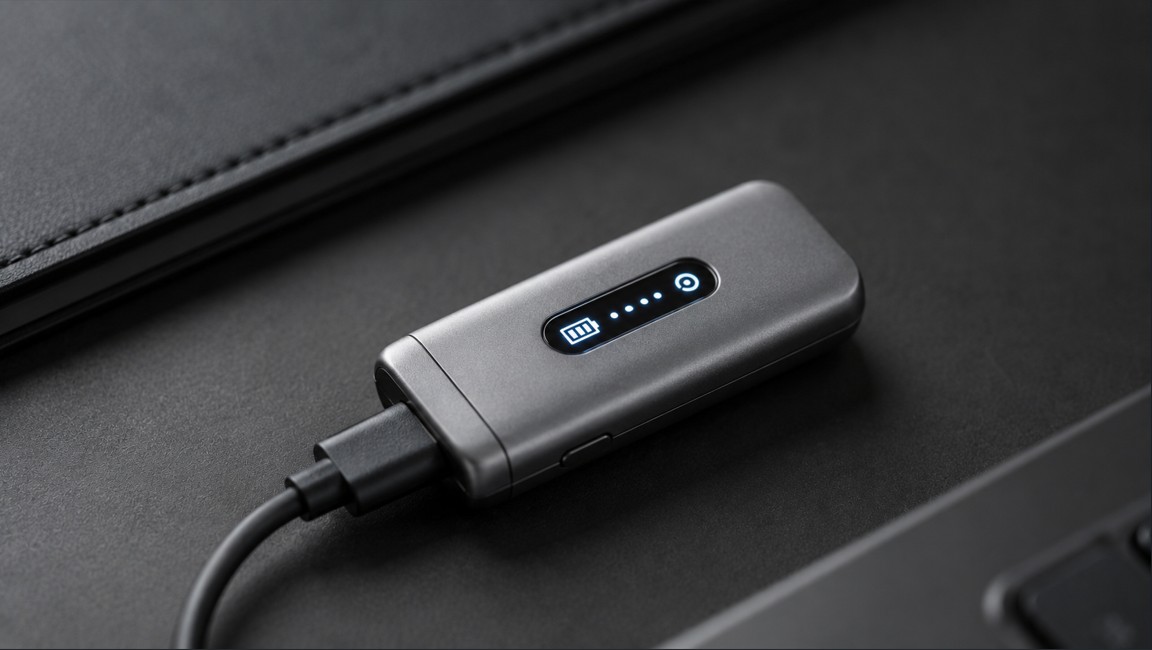
Then the tiny screen arrived, and by 2026 it is everywhere. Earbud cases show charge percentages. Luggage tags display battery icons. Power banks went from four mystery LEDs to full digital readouts. Even disposable vapes, possibly the most throwaway product category in existence, now ship with small colour displays. The cost of a basic OLED or LCD panel fell so far that designers of ten-dollar products suddenly had a tool that used to be reserved for smartphones, and the interesting question is what they chose to do with it.
The two questions every product gets asked
Strip away the categories and almost every battery-powered consumable gets asked the same two questions by its owner: how much power is left, and how much of the consumable remains. Ink, fuel, liquid, charge. The entire history of pre-screen product design is a series of workarounds for these two questions. Transparent windows in printer cartridges. Fuel gauges that were really just a float and a guess. The four-blink LED code that every power bank owner has squinted at and failed to interpret.
The tiny screen answers both questions directly, and that turns out to change how people feel about the object. A product that reports its own state stops being an appliance and starts being a device. The difference sounds semantic until you watch someone interact with one. People check a status screen the way they check a phone, with a small habitual glance that builds a relationship with the object. Nobody ever had a relationship with a blinking LED.
Good information design at the two-centimetre scale
Designing for a screen the size of a thumbnail is its own discipline, and the constraint is brutal. There is room for two numbers and maybe an icon. Typography matters enormously at this scale: a heavy geometric numeral reads instantly at arm’s length, while anything delicate turns to mush. Colour has to do semantic work, with green-to-red gradients standing in for labels there is no room to print. The best of these micro-interfaces feel obvious, which is the highest compliment information design can earn.
The worst of them treat the screen as decoration. Animated mascots, scrolling brand names, novelty wallpapers on a product that will be in a landfill within a month. When a display shows you things you cannot act on, it is ornament. When it shows you the two numbers you actually need, it is interface. The gap between those two choices is the gap between a designer who asked what the user needs and one who asked what the panel can do.
The strangest case study: the disposable that reports its own death
The most instructive example of the whole trend is also the least expected one. Disposable vapes spent years as the ultimate black box, a sealed product that gave no warning before the battery quit or the liquid ran dry, usually at the least convenient moment. In 2026 the better devices in the category carry a colour display showing battery percentage, liquid level, and a running usage count. The market leader’s Geek Bar disposables are the clearest example of the screen done properly: two readouts, no ornament, legible in half a second. A product explicitly designed to be discarded now communicates its own remaining lifespan, which is either a small absurdity or a small triumph of user-centred design, depending on your mood. I lean toward triumph. The two oldest frustrations in that product category were unknowable battery and unknowable liquid, and a thumbnail of glass solved both.
There is also an honest commercial logic underneath it. When a product can prove it delivered its full advertised lifespan, the claim on the box stops being a matter of faith. The screen is the receipt.
What it signals for design generally
The migration of the status display down the price ladder is one of those shifts that looks trivial and is not. It means the floor for product communication has permanently moved. Once buyers experience a category where the product reports its own state, the categories that stay silent start to feel broken. It happened with phone batteries, then earbuds, then the humble power bank, and now products that cost less than lunch.
For designers, the lesson is the old one restated at a new scale. The screen is not the feature. The answer is the feature. The products getting this right in 2026 are the ones using two square centimetres of glass to answer the only two questions their owner ever had, and the ones getting it wrong are proving that you can ship a display and still tell the user nothing. The technology became cheap. The discipline did not.